| |
 The evolution of name Delhi from Indrapastha had been through several stages. During the 8th and 9th century Tomar Rajputs names it Dhillika, which sooner or later was picked up in collonial speech as Delhi. The evolution of name Delhi from Indrapastha had been through several stages. During the 8th and 9th century Tomar Rajputs names it Dhillika, which sooner or later was picked up in collonial speech as Delhi.
The early history of Delhi dates back to about 3000 years ago, is an interesting mixture of myth and reality. The strategic location of Delhi had attracted the attention of almost every king to conquor in this part of the world. The earlier reference to Delhi as a settlement is make in the Hindu epic “ Mahabharat”, which states the pandavas brothers of the Hastinapur Empire chose to Develop its “Khandavprasth”, part of Indraprastha which included construction of a fort and made it the capital of their new kingdom in 1450 BC.
The 1st city of Delhi was built by the Tomar king Anand Pal, in 1069 AD at Mehrauli. It was further improved by his successors – Prithviraj Chauhan, The only Hindu king who ruled Delhi, was a famous warrior and Qutab – ud – din Aibak, The first Muslim Sultan of Delhi. He started the construction of the Qutab Minar which sill dominates the landscape of Delhi.
Allaudin Khilji, one of the greatest Sultans, Built a magnificent new city “Siri” on the North East side of Mehrauli in the 11th century. This prosperous city was located on the North East side of the original Tomar Township, came to be the 2nd medieval city of Delhi.
Ghiyasuddin Tughlak seized power from Allaudin Khilji in 1321 he built the 3rd city of Delhi “ Tughlakabad” in the low hills of South Delhi, A few kilometres east of the Qutab Minar. But Tughlakabad was inhabitated for only 5 years. The remains of Tughlak rule were wiped away by the visitation of Timur – the tartar (Also the terrible) who seized the city in 1398 and demanded vast sums of money from people as ransom, When a few soldiers were killed while collecting money house to house, Timur ordered the massacre of Delhi’s entire population. Then the Lodhi dynasty came to power ( 1451 – 1526 ). They built no cities in Delhi, except mosques and tombs.
Ghiyasuddin. Son and successor of Sultan – Muhammad – Bin – Tughlak, built “Adilabad” just south of Tughlakabad, but soon got abandoned. He moved north and built Jahanpanah – Delhi’s 4th city between Lalkot and Siri in 1334 AD. Muhammad Shah, A brilliant yet eccentric ruler transferred the capital from Delhi to Daulatabad in Southern India (Deccan). The move was ultimately failed and Delhi resumed the status of the capital once again.
Feroz – Shah – Tughlak son of Sultan Muhammad – Bin – Tughlak created his own city “Ferozabad” in 1351 the 5th city of Delhi, along the banks of the river Yamuna. Feroz Shah was a great builder. He brought and erected an eight meter tall and weighing 27 tons glittering emperor Ashoka’s Pillar from topra, Punjab. It still stands in kotla Firoz Shah. He also built splendid palaces, mosques and gardens.
After the historic battle of Panipat in (1526 – 30), Babar the first threat Mughal emperor invaded India and set himself up as the ruler of Hindustan. Hid don and successor Humayan started building the Mughal Capital of “Dinapanah” during his regime. . In 1540 Sher Shah Suri the afghan invader drove to Humayun out of Delhi and built a mighty empire with the best administration system that the cit had ever seen in the sixth city of Delhi “Shergarh” which extended from the Purana Qila to the edge of Firoz Shah Kotla. In 1555, Humayun regained the kingdom of Delhi and once again the capital passed in to the hand of the Mughals. Ruins in and around the Purana Qila testify to this city. Under the flourishing rule of Akbar the caoital was transferred to Agra.
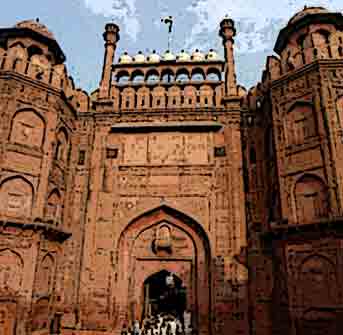
The 7th city of Delhi Shahjahanbad was founded by Mughal emperor Shahjahan in 1638 and completed in 1649. He built the Lal Qila and the huge wall surrounding the city with 14 gates, many of which still exist. This city was called Old Delhi, Red Fort, Jama Masjid, Moti Masjid, Fatehpuri Masjid, and Chandni Chowk etc, which remain even today. Shahjahan decided to shift the capital from Agra to Delhi in 1648.
The British East India Company was setup at Calcutta in 1690.
After the decline of the Mughal Empire started during the regime of Auranzeb, Delhi experienced with carrying degrees of violence and extents of massacres. Nadir Shah sacked Delhi in 1738-39, Ahmad shah Abdali in 1756-57, The Marathas in 1785,
Surviving each haven in and around Shahjahanabad grew the havelis, Katras and Mohallas.
In 1857-58 The Indian Mutiny or great Revolt tool place in various parts of the Country including Delhi against the British Rule.
In 1885 the Indian National Congress was founded which gave Indians a platform from which to demand freedom from British Rile in India.
The 19-century saw the British East India Company rise to power as the Bahadur Shah Zafar the last king of the Mughals surrendered to the British rulers thereby paving the way for a new dynasty in Delhi. But under the British rule, Delhi was only of second importance as Calcutta was the capital of British India. In the spectacular Coronation Durbar help in December 1911, King George V formally announced the transfer f he British India capital to Delhi.
The famous architects Sir Edward Lutyens and Sir Herber Baker were given the task of designing New Delhi, The 8th city of Delhi, raisina hillsouth of Shahjahanabad was chosen as the pivotal point and Rashtrapati Bhavan along with the administrative, headquarters parliament etc were built here. In January 1931 New Delhi was inaugurated as the imperial capital of the British Rule and the capital of the Indian Union.
The long felt desire of the Indians was fulfilled on the 15th of august 1947 when the national tricolour was unfurled by the then Prime Minister Jawahar Lal Nehru on the Red Fort, And since then every year on this day the tricolour is unfurled by the prime minister of India
|
 |
 |